Bol.com Cross-Border Selling: VAT, OSS, and Automated Bookkeeping
BolMoneybird Team
team@bolmoneybird.nl
Expanding your Bol.com sales beyond the Netherlands is one of the most natural growth steps for an established seller. Bol.be gives you direct access to over eleven million Belgian consumers, and Germany offers an even larger market for ambitious sellers. But the moment you sell across borders, your VAT obligations become significantly more complex. Which rate applies to a Belgian customer? Do you need to register with the Belgian tax authority? And how do you keep your Moneybird administration correct when you owe VAT in multiple countries?
This article explains the rules clearly, helps you decide when the OSS scheme is the right choice, and shows how BolMoneybird automates the hard parts.
The threshold and the OSS scheme
Since 1 July 2021, the EU-wide One-Stop-Shop (OSS) scheme applies to distance sales to consumers. The core rule is straightforward: once your total revenue from consumers in other EU countries combined exceeds 10,000 euros per year, you must charge and remit VAT at the rate of the customer’s country.
Below that threshold you can continue applying Dutch VAT rates. But most serious Bol.com sellers cross that line faster than expected. A few hundred orders via bol.be and you are already past it.
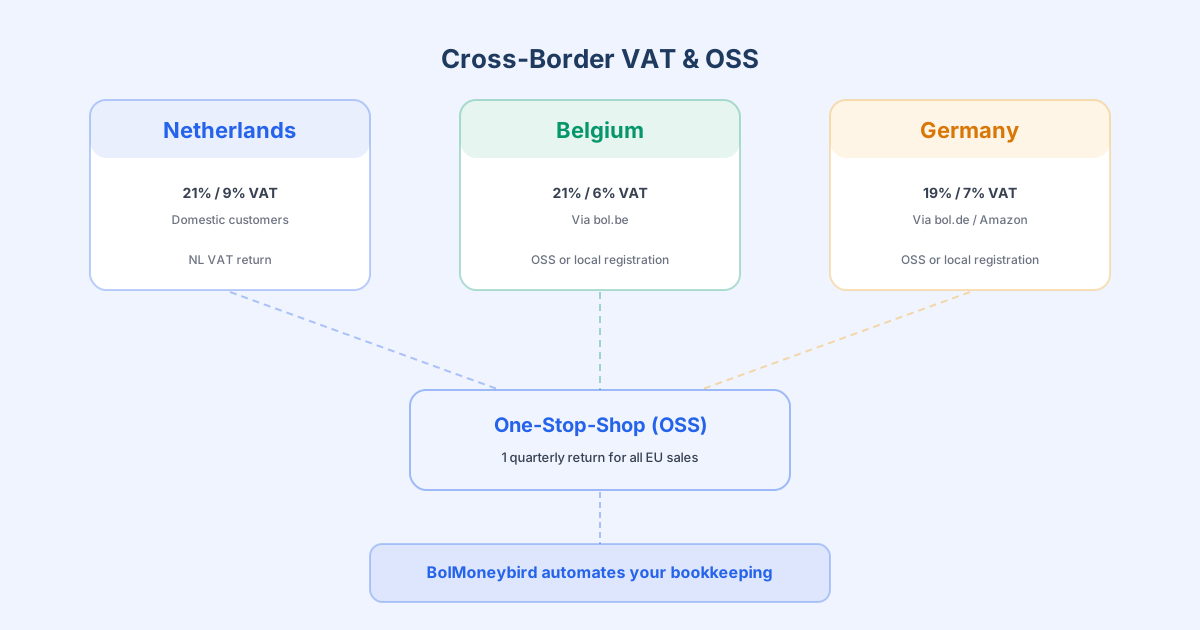
With the OSS scheme you do not need to register for VAT separately in every EU country. You register once with the Dutch Tax Authority (Belastingdienst) and file a combined quarterly return. In that return you report revenue and VAT per EU country. It is administratively straightforward, though there are situations where it is not sufficient on its own.
VAT in Belgium: what changes for you?
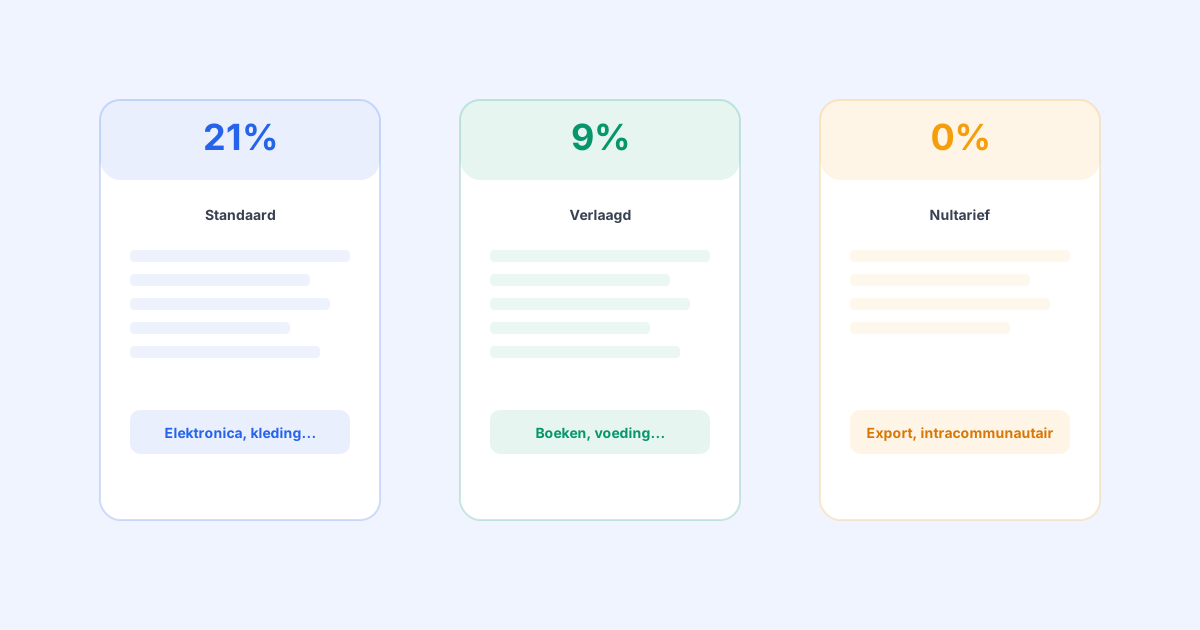
Belgium is the most common first foreign market for Dutch sellers. It shares the standard VAT rate of 21%, but its reduced rate is 6% rather than the Dutch 9%. This means that for certain product categories, including books, food, and medicines, you must apply a different rate than you would for Dutch customers.
Bol.com facilitates sales via bol.be, but the VAT responsibility remains with you as the seller. Your invoice to a Belgian customer must carry the correct Belgian rate, and that rate must also end up in your bookkeeping.
What if you stay below the threshold?
As long as your total EU revenue outside the Netherlands stays under 10,000 euros, you can apply Dutch rates and file a normal NL return. But once you cross the threshold, Belgian rates apply retroactively for the entire calendar year. Monitoring your EU revenue throughout the year is therefore not optional.
Expanding to Germany
Germany has a standard VAT rate of 19% and a reduced rate of 7%. If you sell via platforms like bol.de or Amazon.de to German consumers, the same threshold and OSS rules apply. Cross the 10,000 euro mark and every sale to a German customer requires 19% or 7% VAT, remitted via OSS.
Germany has historically enforced VAT compliance strictly for foreign e-commerce sellers. It is a market with significant upside, but one where your administration must be completely in order before you scale. Getting the VAT wrong is not just a bookkeeping problem: it can lead to back-payments, fines, and complications with marketplace eligibility.
OSS versus local VAT registration
The OSS scheme is not always the only option, and in some cases it is not sufficient. There are situations where you are legally required to register locally in another EU country.
Local registration is mandatory when:
- You store inventory in a fulfillment center abroad (for example Amazon FBA in Germany or Belgium)
- You make B2B sales to businesses in another EU country where the buyer applies the reverse charge mechanism
- You use certain call-off stock arrangements across borders
In those cases you need a local VAT number and must file local returns. This is administratively heavier than OSS, but sometimes unavoidable.
For most Bol.com sellers who sell exclusively to consumers and keep their inventory in the Netherlands, OSS is the simplest and most practical route. For a thorough overview of how VAT rates work per product category, see our article on VAT rates for Bol.com products.
How bookkeeping errors happen
The biggest risk with cross-border selling is not understanding the rules but executing on them correctly. Errors typically occur in three places.
First, applying the wrong rate. If your system does not know that a Belgian customer deserves the 6% rate on a book, it will automatically apply 9% (NL) or 21%. That either means you have overcharged VAT, hurting your margins, or undercharged it, creating a liability.
Second, missing the threshold. Sellers who do not actively track their EU revenue outside the Netherlands do not know when the OSS obligation kicks in. Correcting this retroactively is expensive and time-consuming.
Third, incorrect entries in Moneybird. Even if you invoice the right amounts, those amounts must land correctly in your accounting. A wrong VAT percentage on a booked invoice leads to an incorrect VAT return. For a complete guide to preparing your Bol.com VAT return correctly, read our article on preparing your VAT return as a Bol.com seller.
How BolMoneybird handles this automatically
BolMoneybird is built for exactly this kind of complexity. The connection between Bol.com and Moneybird does not just process Dutch orders correctly: it accounts for the customer’s country and applies the corresponding VAT rules.
Country-based VAT mapping
BolMoneybird automatically detects the delivery country for every order. Based on that country, it applies the correct VAT rules: Dutch rates for NL customers, Belgian rates for BE customers, German rates for DE customers. This happens at the level of individual invoice lines, so products with a reduced rate are handled correctly even in mixed orders.
Correct OSS accounting in Moneybird
Once you exceed the OSS threshold, BolMoneybird ensures that foreign VAT is booked separately in Moneybird. When you file your quarterly return, you can immediately see how much VAT you owe per EU country without manually sorting through hundreds of transactions.
Real-time accuracy, not end-of-quarter reconstruction
Because everything is automated, you have an up-to-date picture of your VAT position at any moment. You do not need to piece things together at quarter-end. You can see today exactly what you owe to the Dutch, Belgian, and German tax authorities. For a broader look at how automation transforms your Bol.com accounting, read our article on automating your accounting as a Bol.com seller.
A practical checklist for cross-border selling
If you are just starting to sell in Belgium or Germany, these are the steps to take before your first cross-border orders arrive:
- Check your current EU revenue outside the Netherlands against the 10,000 euro threshold.
- Register for the OSS scheme via the Belastingdienst if you expect to exceed the threshold.
- Confirm that Moneybird is configured to handle multiple VAT rates and countries.
- Connect BolMoneybird so that every Bol.com order is automatically booked with the correct rate and in the right VAT box.
Cross-border selling on Bol.com is a genuine growth opportunity. Capturing that opportunity requires your administration to handle the complexity without breaking down. BolMoneybird gives you that foundation without adding manual work to your workflow.
Start today
Ready to make sure every cross-border Bol.com sale is booked correctly and your OSS filings are always accurate? Try BolMoneybird for free and see how automatic VAT mapping and Moneybird synchronisation save you hours every month and prevent costly errors.
Tags
Share