Cash Flow Management for Bol.com Sellers: Keep Your Finances on Track
BolMoneybird Team
team@bolmoneybird.nl
Orders are coming in, revenue is growing, but at the end of the month there is less money in your account than expected. Sound familiar? This is one of the most common problems Bol.com sellers face. Your profit margin looks fine on paper, but cash flow tells a different story. In this article we explain how Bol.com payouts affect your liquidity, which cost items put the most pressure on your cash flow, and how to use Moneybird to always have an up-to-date picture.
Why cash flow is different from profit
Profit and cash flow are not the same thing. You can be profitable while simultaneously having liquidity problems. That sounds contradictory, but for Bol.com sellers it is a daily reality.
Say you sell 20,000 euros worth of products on Bol.com in July. The payout for those sales arrives partly in the week after the sale, but supplier invoices may need to be paid 30 or 60 days earlier. If you are also replenishing stock for the autumn, a serious gap can emerge between what you spend and what comes in.
This is the liquidity question: it is not about how much you earn, but about when the money arrives in your account.
How does Bol.com payment work?
Bol.com pays sellers weekly, usually on Tuesday or Wednesday. The payout covers the previous week’s sales, minus commissions, any return cost reconciliations, and Fulfilment by Bol.com fees.
A few things to keep in mind:
Return reconciliation delays payouts. When customers send products back, those costs are deducted from your next payout. A high return rate can significantly reduce your weekly payment.
The payment specification appears after the fact. The exact breakdown of your payout (commissions, returns, advertising costs) is only available after the payment has been made. You cannot see in advance exactly what you will receive.
Advertising costs are invoiced separately. Bol.com sends a separate invoice for advertising costs. You pay this yourself, separately from the payout you receive. Read more about processing these costs in our article on Bol.com advertising costs in Moneybird.
The three biggest liquidity risks for Bol.com sellers
1. Stock investments come before revenue
Buying stock costs money now. Sales and payouts come later. For seasonal products, such as toys before Sinterklaas or garden items in spring, this gap can span weeks to months.
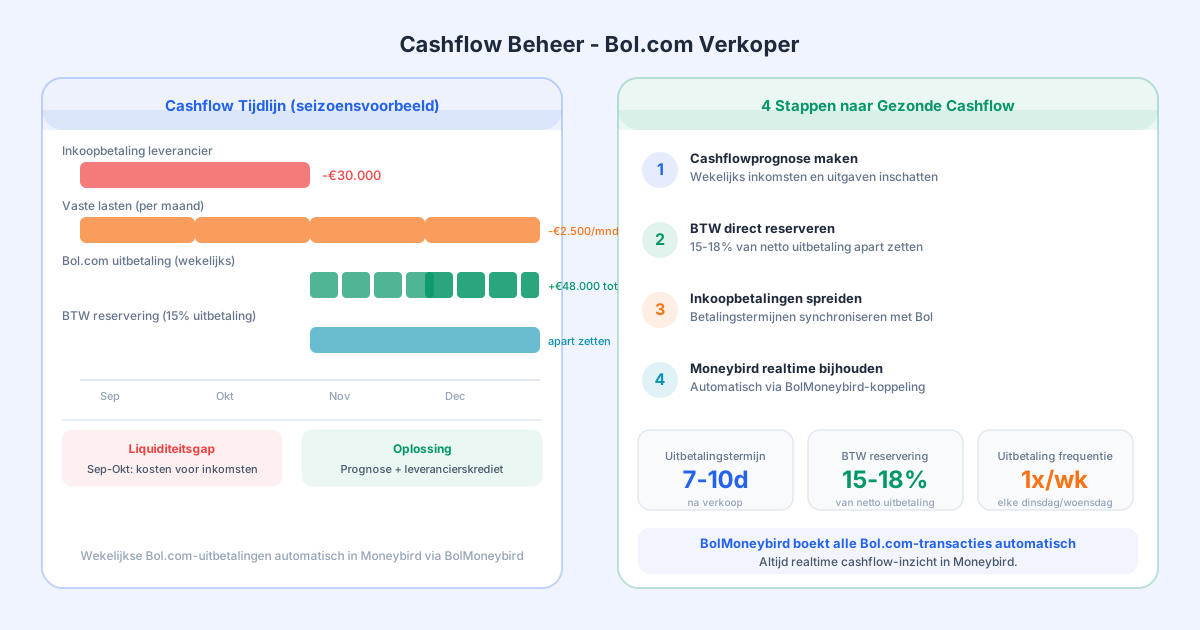
A practical example: you order 30,000 euros worth of products in September for peak season. Your supplier offers 30-day payment terms, so you pay in October. Sales peak in November. Payouts for those sales arrive in November and December. In the weeks in between, you need to pay both the supplier and your fixed costs, while income is still limited.
2. VAT payments come as a surprise
As a VAT-registered business, you pay VAT to the tax authority every quarter. That payment is based on your revenue minus input tax. For a seller with 50,000 euros in quarterly revenue, the VAT payment can run to 8,000 to 10,000 euros.
Many sellers do not set this money aside. They book the revenue and forget that a portion of their income already belongs to the tax authority. The result: at the end of the quarter there is an unexpected large payment due. Read more about preparing your VAT return as a Bol.com seller.
3. Chargebacks and reversals
Customer complaints, damaged products, or disputes can lead to refunds that are deducted directly from your next payout. If you do not anticipate this, a single large chargeback can throw your cash flow off course.
Cash flow management in practice: four steps
Step 1: Create a cash flow forecast
A cash flow forecast is an overview of expected income and expenses per week or month. For Bol.com sellers, this means:
- Expected payouts based on historical sales and seasonal patterns
- Planned supplier invoices and payment terms
- Fixed costs (subscriptions, staff, warehouse rent)
- Quarterly VAT payments and any corporate income tax
A simple spreadsheet can work for this, but it helps enormously if your accounting package gives you real-time insight into what has already been received and what is still expected.
Step 2: Reserve VAT as soon as income arrives
Transfer a fixed percentage of your Bol.com payout to a savings account every week. If you have an average VAT rate of 21% after deducting input tax, reserving 15 to 18% of your net payout is a safe rule of thumb.
This sounds simple, but many sellers do not do it consistently. An automatic transfer immediately after the Bol.com payout makes this process foolproof.
Step 3: Spread purchase payments
If your suppliers are willing to offer 30 or 60-day payment terms, make full use of that. Try to synchronise purchase payments as much as possible with the Bol.com payout cycle, so you do not have to pay before the money from Bol.com arrives.
Step 4: Use Moneybird for real-time cash flow insight
Moneybird provides an overview of your outstanding invoices, payments to receive, and bills to pay. When all Bol.com transactions are automatically booked in Moneybird, you can see at a glance what your current cash position is and what is expected in the coming weeks.
With BolMoneybird, Bol.com payouts are automatically split into the correct cost categories and posted in Moneybird. You do not need to go through every payment specification yourself to understand what your payout consists of. You always have an up-to-date picture of your liquidity position.
Useful metrics for Bol.com liquidity
To monitor your cash flow, a few metrics are helpful to track:
Average payout lead time: how many days are there on average between a sale and receiving the payout? For Bol.com this is typically 7 to 10 days.
Return rate: a high return rate translates directly into lower payouts and additional processing costs. Track this per product category.
Purchase lead time vs. sales cycle: how long does it take on average from purchase to sale? If this is 60 days and your supplier offers 30-day payment terms, you have a structural financing gap of 30 days.
When to consider external financing
Not every liquidity need is a sign of an unhealthy business. Growth costs money, and temporary financing needs during seasonal peaks are normal. Options to consider:
- Overdraft facility at your bank: for temporary shortfalls, this is the most flexible option.
- Invoice factoring: some financiers purchase your outstanding receivables from Bol.com, allowing you to receive money faster.
- Supplier credit: negotiate longer payment terms if you are a regular customer.
Make sure your accounting package is up to date before approaching a bank for financing. Banks want to see current figures, and if your Moneybird is kept current via BolMoneybird, you have those available in minutes.
Conclusion
Cash flow is an active priority for Bol.com sellers, not an afterthought. The combination of weekly payouts, variable return reconciliations, seasonal peaks, and quarterly VAT payments means you always need to think a few steps ahead.
The foundation is current bookkeeping. If you do not know what is in your account and what is expected to come in or go out in the coming weeks, you are flying blind. With BolMoneybird, all your Bol.com transactions are automatically processed in Moneybird, so you always have real-time insight. Try BolMoneybird for free and take back control of your cash flow.
Tags
Share