Mid-Year Accounting Checkup: Start Q3 Without the Stress
BolMoneybird Team
team@bolmoneybird.nl
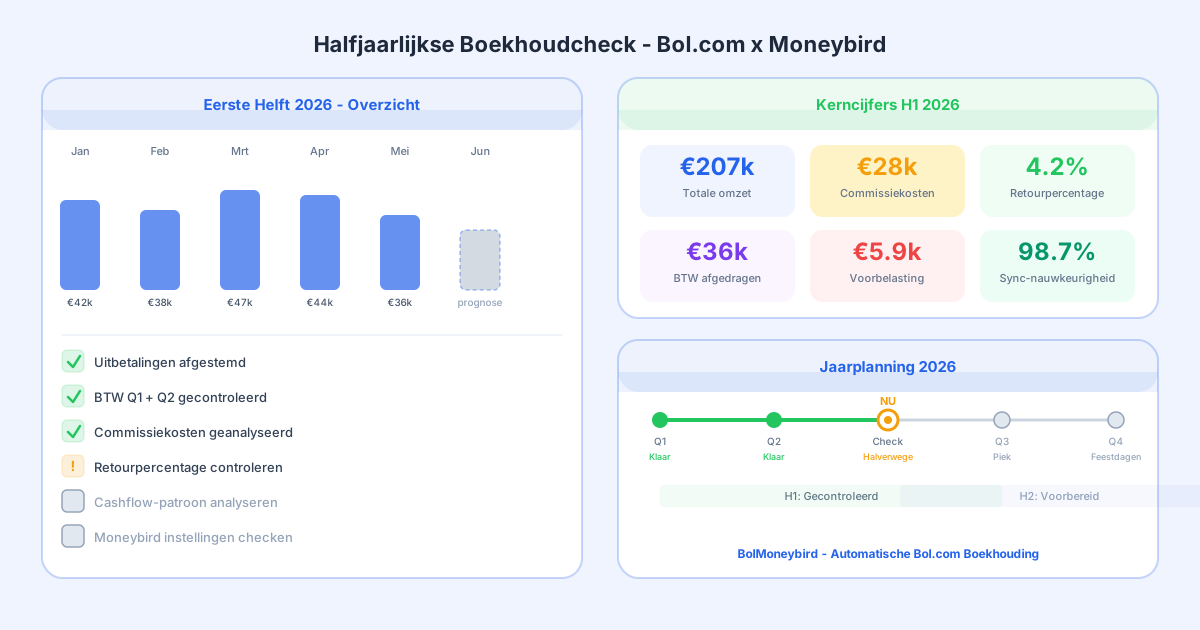
Summer is around the corner. The first half of 2026 is nearly behind us, and the second half is already lined up with challenges: Back-to-school in August, Black Friday in November, and the holiday rush in December. But before you look ahead, it pays to look back. A solid accounting foundation starts with a clean baseline. In this article, we walk you through the mid-year accounting checkup that every Bol.com seller should perform. Not as a dry administrative chore, but as a strategic moment to get a firm grip on your numbers and head into the second half of the year with confidence.
Why Halfway Through the Year?
It might sound odd to pause and review your books in the middle of the year. Most entrepreneurs only think about accounting at year-end or when the quarterly VAT return is due. But right now, in the relatively quiet weeks of June, you have the space to give your administration a thorough review.
There are three reasons why this timing is so valuable:
You have two quarters of data. After two full quarters, you can spot patterns. Which product categories are growing? Where are you paying the most commission? Are there structural return issues? With just one quarter of data, these patterns are often invisible. Halfway through the year, you have enough information to draw reliable conclusions.
The busy season is coming. Starting in September, sales volume for most Bol.com sellers gradually increases, peaking around Black Friday and the holidays. Problems in your accounting that feel small now will become large then. A missing invoice at 20 orders per day is annoying. At 200 orders per day, it becomes a nightmare.
You can still course-correct. The first half of the year is done, but the second half is wide open. If you discover now that your margins are lower than expected, or that your VAT payments are off, you still have six months to adjust.
Check 1: Reconcile Your Bol.com Payouts
The very first check is simple but critical: do your Bol.com payouts match what is recorded in Moneybird? Bol.com pays out weekly, and each payout consists of dozens or hundreds of individual transactions. It is easy to lose track.
Pull up your bank statements from January through May and compare the total Bol.com payouts with the total in Moneybird. If there is a discrepancy, you have a missing or duplicate booking somewhere.
The most common causes of differences:
- A payout that is not linked to the correct ledger account
- Manually created invoices that do not match actual sales
- Return credit invoices that are missing or incorrectly booked
For a systematic approach to this process, read our guide on reconciling Bol.com payouts in Moneybird, where we walk through the full reconciliation process step by step.
Check 2: Verify Your VAT Handling
After two quarters of VAT returns, it is time to verify that everything has been processed correctly. This goes beyond checking whether you filed on time. You want to be certain that the amounts are accurate.
For each quarter, verify the following:
- Does the revenue in your VAT return match your actual Bol.com revenue?
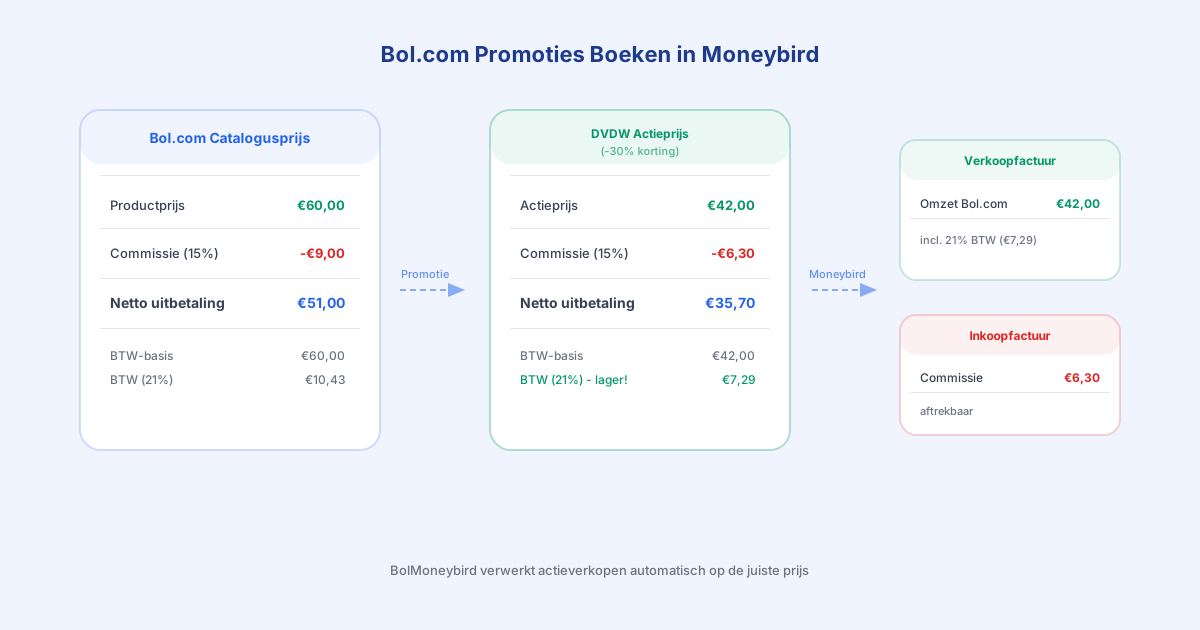
- Are all commissions booked with the correct VAT rate (21%)?
- Are returns correctly processed as credit invoices?
- Have you included the input VAT on your Bol.com commissions?
A common mistake is that sellers forget to reclaim the VAT on Bol.com commissions. Bol.com charges 21% VAT on commission fees, and you can deduct this amount as input tax. Over half a year, this can easily add up to hundreds or even thousands of euros. Our article on preparing your VAT return as a Bol.com seller explains exactly how to handle this correctly.
Check 3: Analyse Your Commission Costs
The commission that Bol.com charges is typically the largest expense after cost of goods for most sellers. Yet it is surprising how many entrepreneurs lack a clear picture of what they actually pay in commission fees.
Halfway through the year is the perfect moment to analyse this. Export your commission costs from Moneybird for the first five months and compare them with your revenue. Calculate your effective commission percentage. Is it higher than expected? Several factors could be at play:
- Your product mix has shifted toward categories with higher commission rates
- Bol.com adjusted rates in certain categories as of 1 January 2026
- You are selling more low-priced products, where the fixed commission component weighs more heavily
With this insight, you can make strategic decisions for the second half of the year. Perhaps it makes sense to adjust your assortment, revise your pricing, or focus on categories with lower commission rates.
Check 4: Assess Your Return Rate and Financial Impact
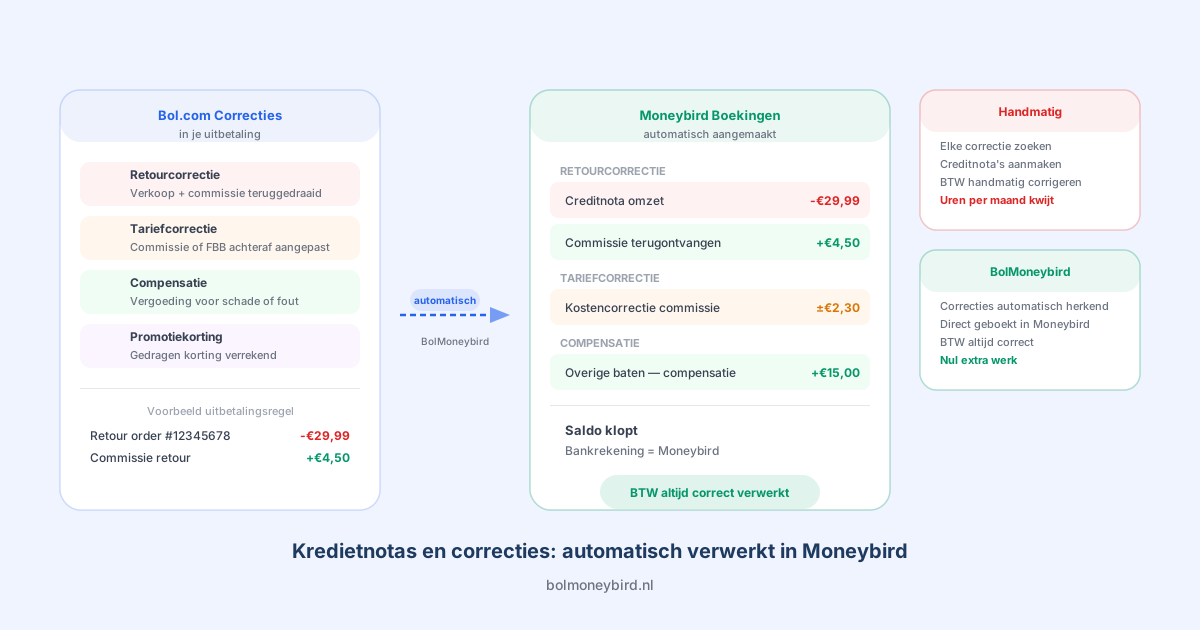
Returns are an unavoidable part of selling on Bol.com, but their financial impact is often underestimated. When a product is returned, you lose more than just the revenue; you also pay return shipping costs, and in some cases Bol.com does not refund the full commission.
Review your return rate for the first half of 2026. How does it compare to the average in your category? And more importantly: have all returns been correctly processed in Moneybird as credit invoices?
Spot-check a sample of returns:
- Has a credit invoice been created for the full amount including VAT?
- Are return shipping costs correctly booked?
- Is the VAT on the credit invoice correct?
A return rate of 5% might not sound dramatic, but at an annual revenue of 500,000 euros, that amounts to 25,000 euros in returns. If those are not correctly booked, your entire financial picture is off.
Check 5: Evaluate Your Cash Flow Pattern
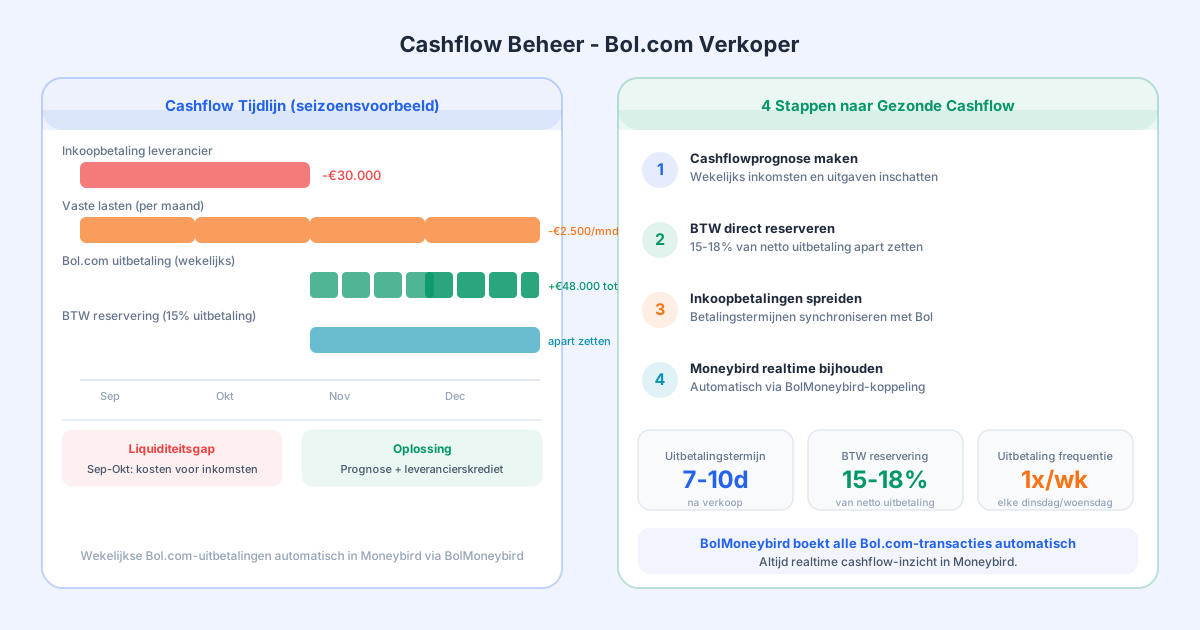
With five months of data, you can get a clear picture of your cash flow pattern. When does money flow in? When do supplier payments fall due? Are there months when things get tight?
This is especially important as you prepare for the busy second half. Many sellers need to purchase extra inventory in September and October for the holiday peak, while revenue has not yet reached its highest level. This can create a cash flow dip that you need to bridge.
By analysing your cash flow pattern now, you can:
- Arrange a credit facility in time if needed
- Plan payment schedules with suppliers
- Set aside reserves for VAT payments in Q3 and Q4
Check 6: Review Your Moneybird Settings
Over the past months, you may have added new products, started selling in new categories, or Bol.com may have introduced changes. It is wise to verify that your Moneybird settings are still current.
Check the following:
- Are all ledger accounts correctly configured?
- Are VAT percentages still accurate (watch for rate changes)?
- Is the automated integration working properly?
- Are new product categories being mapped correctly?
If you use BolMoneybird, many of these settings are updated automatically. The VAT mapping always follows the current Bol.com rates, and new categories are automatically recognised. But it remains wise to review settings periodically.
Check 7: Compare Results Against Your Forecast
If you set a revenue forecast or budget at the start of the year, now is the time to compare. Are you on track? Are your margins in line with expectations?
Many entrepreneurs only make this comparison at year-end, but by then it is too late to adjust course. Halfway through the year, you can still take action. If revenue is behind target, you can ramp up marketing efforts. If margins are lower than planned, you can analyse and optimise your cost structure.
Create a simple overview:
- Actual H1 revenue versus budgeted H1 revenue
- Actual commission costs versus budgeted commission costs
- Actual return rate versus budgeted return rate
- Actual net profit versus budgeted net profit
This overview gives you an at-a-glance view of where you stand and where adjustments are needed.
The Role of Automation in Your Mid-Year Checkup
A mid-year accounting checkup is only effective if your data is reliable. And that is exactly where automation makes the difference. If you are still manually creating invoices or reconciling payouts, there is a good chance that errors exist in your data. Errors that render your mid-year analysis worthless.
With an automated integration between Bol.com and Moneybird, like the one BolMoneybird provides, you know that:
- Every order is automatically created as an invoice
- Every return is processed as a credit invoice
- All commissions are correctly booked with the right VAT rate
- Payouts are automatically reconciled
This means your mid-year checkup is not about hunting down administrative mistakes, but about analysing your results and making strategic decisions. And that is exactly where you want to spend your time as an entrepreneur.
Curious how an automated integration streamlines your accounting? Explore the benefits of scalable accounting for growing Bol.com sellers.
Conclusion: Invest Two Hours Now, Save Twenty in Autumn
A mid-year accounting checkup takes about two hours. But that investment pays for itself many times over. You enter the busy second half of the year with clean books, clear insight into your margins, and a plan for the rest of 2026. No surprises at year-end, no stress around the VAT return, and no sleepless nights over missing invoices.
Want to ensure your accounting stays automatically in order for the rest of the year? Try BolMoneybird for free and discover how automated synchronisation changes your bookkeeping for good.
Tags
Share